
CATHINONE
Understanding the Structure and Background of a Cathinone Derivative
Mar
The family of cathinone-based compounds includes a wide range of molecules that share similar chemical foundations but differ slightly in structure. Among these derivatives, mephedrone, commonly referred to as 4-MMC, has become one of the most widely discussed compounds in chemical research and academic discussions.
In this mephedrone 4MMC compound guide, we will explore the origins of this molecule, its chemical structure, how it relates to other cathinone derivatives, and why researchers continue to study this compound as part of the broader stimulant chemical family.
Understanding the background and structure of mephedrone provides useful insight into how small changes in molecular design can produce new compounds within the cathinone framework.
What Is Mephedrone (4-MMC)?
Mephedrone is a synthetic cathinone derivative. This means that it belongs to a class of compounds that are chemically related to cathinone, a naturally occurring stimulant compound originally identified in the Catha edulis plant.
The name 4-MMC refers to its chemical structure, specifically 4-methylmethcathinone. The number “4” represents the position of the methyl group on the aromatic ring of the molecule.
Within the broader cathinone family, mephedrone shares many structural similarities with other derivatives while maintaining its own distinct molecular configuration.
Because of its structure, the mephedrone 4MMC compound guide is often discussed when researchers explore the development and classification of synthetic cathinone compounds.
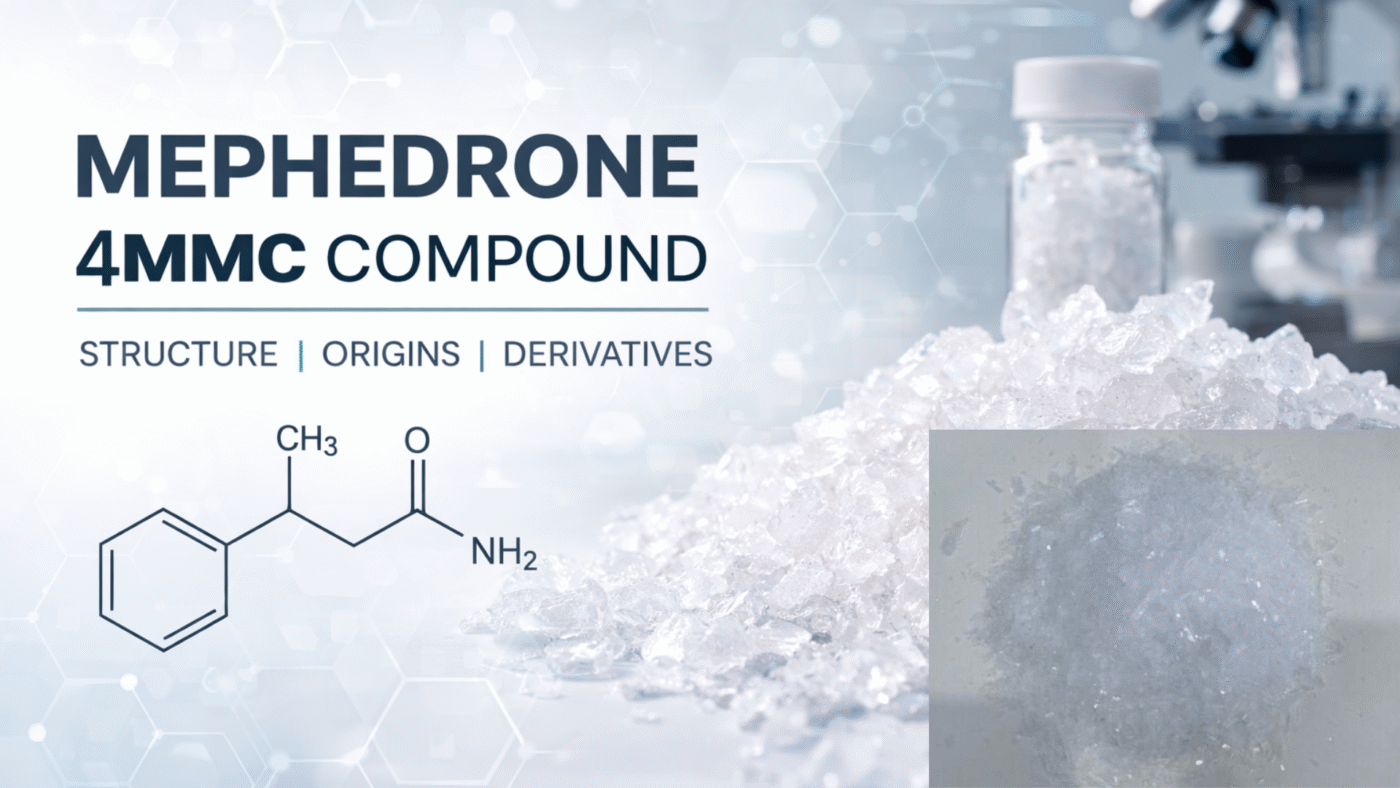
Chemical Structure of Mephedrone
Chemically, mephedrone belongs to the phenethylamine and cathinone class of molecules. The compound contains several structural elements that define its classification.
Key components of the molecule include:
- A phenyl ring that forms the aromatic core
- A beta-keto group characteristic of cathinone derivatives
- A methyl substitution on the fourth position of the ring
- An amine side chain similar to other stimulant-type molecules
These structural elements give the compound its identity within the synthetic cathinone category.
The mephedrone 4MMC compound guide often highlights this structure because it shows how chemists can create new derivatives simply by modifying specific positions within the molecule.
Relationship to Cathinone Compounds
To understand where mephedrone fits within the chemical landscape, it is important to examine its relationship with cathinone itself.
Cathinone acts as the base structure from which many derivatives are developed. Chemists can modify different parts of this structure, producing compounds that share a similar backbone but vary slightly in molecular arrangement.
Mephedrone represents one of these structural variations.
In many chemical classification systems, it is categorized under ring-substituted cathinones, meaning that a chemical group has been attached to the aromatic ring portion of the molecule.
Because of this relationship, the mephedrone 4MMC compound guide is frequently discussed alongside other derivatives within the cathinone family.
Development and Research Interest
Over the years, researchers have studied synthetic cathinones to better understand how molecular changes affect chemical properties.
Mephedrone became one of the more frequently discussed compounds within this category due to its relatively simple structure and its relationship with other phenethylamine derivatives.
Scientists exploring structure-activity relationships often examine molecules like mephedrone to see how small chemical modifications influence molecular behavior.
Within the mephedrone 4MMC compound guide, the compound is often used as an example of how synthetic chemistry can generate new variations of naturally occurring structures.
Physical and Chemical Characteristics
Like many cathinone derivatives, mephedrone has a molecular structure that allows it to interact with biological systems in ways similar to other stimulant-type compounds.
Some characteristics typically associated with cathinone derivatives include:
- Relatively simple phenethylamine-based structure
- Ability to form crystalline or powdered forms
- Molecular flexibility that allows structural modification
From a chemistry standpoint, the compound serves as a useful model for studying how beta-keto substitutions influence chemical behavior.
The mephedrone 4MMC compound guide highlights these features to illustrate how structural elements shape the identity of the compound.
Comparison With Other Cathinone Derivatives
Mephedrone is often compared with other well-known cathinone derivatives to understand similarities and differences in molecular design.
Examples of related compounds include:
- Methylone
- Butylone
- Ethcathinone
- Alpha-PVP
Each of these compounds originates from the same cathinone framework but includes different molecular substitutions.
For chemists studying stimulant-type compounds, these differences are valuable because they demonstrate how structural variation can lead to entirely new molecules.
This comparison is an important part of the mephedrone 4MMC compound guide, as it places the compound within the larger family of cathinone derivatives.
Classification Within Organic Chemistry
In organic chemistry literature, mephedrone is typically categorized in several ways based on its structure.
It can be classified as:
- A synthetic cathinone derivative
- A phenethylamine-related compound
- A ring-substituted cathinone
These classifications help researchers understand how the compound relates to other molecules within similar chemical groups.
The mephedrone 4MMC compound guide uses these categories to organize information about the compound and its related derivatives.
Why Chemists Study Cathinone Derivatives
Cathinone derivatives continue to attract attention within the scientific community for several reasons.
Structural Chemistry
Researchers examine these molecules to better understand the relationship between molecular structure and chemical behavior.
Phenethylamine Research
Cathinone derivatives provide insight into how different substitutions affect compounds within the phenethylamine family.
Molecular Diversity
Because the cathinone framework allows multiple modifications, chemists can create a wide range of derivatives for study.
These factors contribute to the ongoing interest highlighted in the mephedrone 4MMC compound guide.
Final Thoughts
Mephedrone (4-MMC) represents an important example within the family of synthetic cathinone derivatives. Its molecular structure illustrates how chemists can modify a natural compound framework to create new variations with distinct characteristics.
By studying molecules like mephedrone, researchers gain insight into the broader chemistry of stimulant compounds and phenethylamine derivatives.
The mephedrone 4MMC guide provides a foundation for understanding this compound within the wider context of cathinone-based chemistry.
As research continues, these compounds remain an interesting area of study for scientists exploring molecular structure, organic chemistry, and the diversity of synthetic derivatives.
Read More:
Cathinone Compounds Guide: Understanding This Stimulant Family
Cannabinoid Research Powder: Understanding Modern Research Compounds
SGT-151 (Cumyl-PEGACLONE): Chemical Overview and Research Interest
