
RESERCH CHEMICALS
PMK (3,4-Methylenedioxyphenylpropan-2-one): Complete Guide to Uses, Risks, and Legal Status
Apr
Introduction
Chemical compounds play an essential role in modern science, medicine, and industry. However, some substances are also subject to strict regulation due to their potential misuse. One such compound is PMK chemical guide, scientifically known as 3,4-Methylenedioxyphenylpropan-2-one.
In this PMK chemical guide, we’ll explore what PMK is, its chemical properties, legitimate contexts, associated risks, and why it is closely monitored worldwide. This article is purely educational and aims to build awareness, not encourage misuse.
What is PMK?
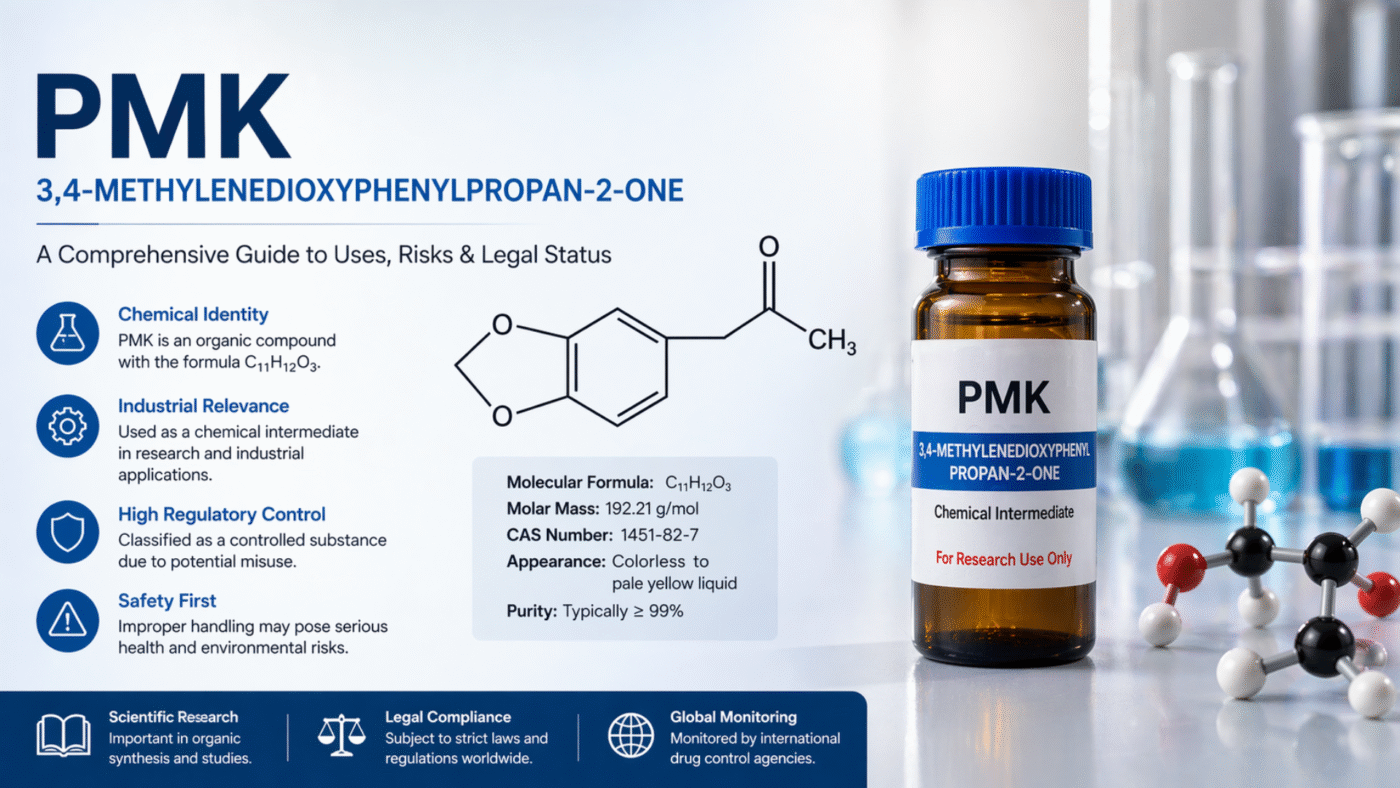
PMK is an organic compound that belongs to the category of phenylpropanoids. It is often discussed in the context of chemical intermediates—substances used in the synthesis of other compounds.
Basic Overview
| Property | Description |
|---|---|
| Chemical Name | 3,4-Methylenedioxyphenylpropan-2-one |
| Common Name | PMK |
| Category | Organic compound |
| Type | Chemical intermediate |
| Appearance | Typically liquid (varies by purity) |
In this PMK chemical guide, it’s important to note that PMK is not a consumer product and is typically handled only in controlled laboratory or industrial environments.
Chemical Structure and Properties
PMK contains a methylenedioxy ring attached to a phenyl group, making it structurally significant in organic chemistry.
Key Properties
- Aromatic compound
- Contains oxygen functional groups
- Reactive intermediate
- Requires controlled storage conditions
These characteristics make it useful in chemical research but also sensitive and potentially hazardous if mishandled.
Legitimate Uses in Science and Industry
While PMK is widely known due to regulatory concerns, it is fundamentally a chemical intermediate, meaning it can play a role in research and industrial chemistry.
Possible Contexts of Use
- Academic chemical studies
- Controlled laboratory experiments
- Development of complex organic compounds
However, in this PMK chemical guide, it’s critical to understand that its usage is heavily regulated and limited to authorized environments.
Why is PMK Regulated?
PMK is classified as a controlled precursor in many countries due to its potential misuse in the synthesis of illegal substances.
Reasons for Regulation
- Potential for chemical misuse
- Association with illicit synthesis
- High demand in illegal markets
- Public health concerns
Because of these factors, governments enforce strict laws on its production, distribution, and possession.
Health and Safety Risks
Handling PMK without proper knowledge or authorization can pose serious risks.
Potential Hazards
Physical Risks:
- Skin and eye irritation
- Harmful vapors if inhaled
- Chemical burns in concentrated form
Environmental Risks:
- Toxic if improperly disposed
- Can contaminate water sources
Operational Risks:
- Requires trained handling
- Needs proper lab safety equipment
In this PMK chemical guide, safety should always be the top priority when discussing any chemical compound.
Legal Status Around the World
PMK is listed as a controlled substance or precursor in many jurisdictions.
General Legal Overview
| Region | Status |
|---|---|
| United States | Strictly controlled |
| Europe | Regulated precursor |
| India | Controlled under narcotics laws |
| Global | Monitored internationally |
Unauthorized handling can result in severe legal consequences, including fines and imprisonment.
Common Misconceptions
1. “It’s just a normal chemical”
While PMK is a chemical intermediate, its regulation makes it far from “ordinary.”
2. “It can be freely used in labs”
Only licensed and regulated facilities can handle such substances.
3. “No risk if handled carefully”
Even trained professionals follow strict protocols due to its risks.
Safe Handling Awareness
Even in academic contexts, chemical safety is essential.
Basic Safety Principles
- Use proper protective equipment (PPE)
- Work in controlled lab environments
- Follow legal guidelines strictly
- Avoid unauthorized access or storage
Comparison with Other Chemical Intermediates
| Compound Type | Regulation Level | Risk Level |
|---|---|---|
| Common solvents | Low | Moderate |
| Industrial reagents | Moderate | High |
| PMK | Very High | Very High |
This comparison in the PMK chemical guide shows why PMK stands out in terms of regulation and concern.
Importance of Awareness
Understanding regulated chemicals is important not just for scientists but also for the general public.
Why Awareness Matters
- Prevents misuse
- Promotes safety
- Encourages legal compliance
- Supports responsible science
Conclusion
PMK (3,4-Methylenedioxyphenylpropan-2-one) is a powerful and tightly regulated chemical compound. While it has relevance in scientific contexts, its risks and legal restrictions make it unsuitable for general or unauthorized use.
This PMK chemical guide provides a clear and responsible overview—helping readers understand the compound without encouraging unsafe or illegal practices.
FAQs
What is PMK used for?
It is mainly known as a chemical intermediate in controlled research settings.
Is PMK legal?
It is highly regulated and often restricted to licensed entities.
Is PMK dangerous?
Yes, improper handling can pose health and environmental risks.
Can individuals use PMK?
No, it is not intended for public or personal use.
Read More:
Dermorphin 5mg: A Complete Guide to Effects, Risks, and Research
Methcathinone: Risks, Effects, and UK Legal Status
Mounjaro for Weight Loss and Diabetes Management: A Complete Guide
